
Every hand hygiene campaign starts with the same simple message: wash your hands. Twenty seconds, soap, clean water, and a thorough dry. It is one of the cheapest and most effective public health interventions available to us.
But here is the gap most facility managers discover only later — people rarely wash their hands the way the guidance assumes. They wash in a hurry. They pump too little soap from soap dispensers, run water over their palms for five seconds, shake their hands dry without hair dryer, and walk out into the building with damp fingers that transfer germs to door handles, elevator buttons, and shared keyboards.
That is why hand hygiene is not a single act. It is a system: the soap that reaches the hands, the soap dispenser that delivers it, and the hand dryer that finishes the job. When one part of that chain fails, the rest is compromised.
This article looks at handwashing from the inside out — and at why soap dispensers and hand dryers deserve a place in every serious hygiene specification.

The Part of Handwashing Nobody Measures
The published guidance is consistent. The U.S. CDC advises scrubbing with soap for at least 20 seconds, covering backs of hands, between fingers, and under nails, then drying thoroughly. The WHO’s hand hygiene programme makes the same point in clinical settings: the moment after washing — while hands are still wet — is the moment of highest risk.
Wet hands are a problem for two reasons. First, damp surfaces pick up and pass on microorganisms far more readily than dry ones. Second, residual moisture left on the skin can cause irritation and cracking — and broken skin is both uncomfortable for the user and harder to keep clean.
So the real question is not “do people wash their hands?” but “does the washroom make it easy to wash and dry correctly?” Three things decide the answer:
- Is the right amount ofsoap dispenser reliably available?
- Is the soap itself clean and uncontaminated?
- Does the hand dryerdrying step actually dry?
Each of those maps to a piece of equipment.
Soap dispensers: the dose that decides the wash
A Soap dispenser looks like a small detail. In practice it is the element that determines whether a proper wash happens at all.
Consistent dosing. Manual pump bottles deliver whatever the user gets out of them — often one weak squirt when the bottle is half empty, which is not enough soap to form the lather needed for effective scrubbing. Modern sensor-activated soap dispensers deliver a fixed, calibrated dose every time. The wash starts correctly, which is the only way it ends correctly.
Sealed, no-touch soap paths. Refillable open-top reservoirs are open invitations to contamination: hands, water, and dust reach the soap, and the soap reaches the next user. Sealed cartridge systems with a locked pump head keep the soap in a closed loop from factory to hand, and non-contact activation removes the last point of physical contact in the chain.
Less waste, less maintenance. Foam soap dispensers in particular use less product per wash than liquid-soap pumps while covering the hands more efficiently. For high-traffic sites — airports, hospitals, schools, factories — that is a measurable operating saving, and fewer refills means fewer moments when a dispenser sits empty.
Visible reliability. An empty or broken dispenser tells users exactly one thing: hygiene is not a priority here. Automatic low-soap indication and a robust, lockable housing change that message entirely.

Hand dryers: the step that finishes the job
Drying is routinely treated as the optional part of handwashing. It is not.
As noted above, wet hands transfer pathogens more efficiently than dry hands, and repeated wet-to-dry cycles without proper drying leave skin prone to irritation. In facilities where paper towels run out, are not restocked, or are simply not where the user needs them, the drying step disappears — and with it, much of the benefit of the wash itself.
A well-specified hand dryer closes that gap reliably:
Drying speed that people actually accept. The practical constraint is not the technology, it is the user’s patience. Hand Dryers that take 45 seconds get abandoned after 10. High-speed models in the 10–15 second range are used correctly, which means hands actually leave dry.
Filtered air. A dryer draws in the air of the washroom and blows it across clean hands. That is why HEPA filtration matters — it keeps the airstream free of particulates and protects the quality of the hand hygiene routine rather than undermining it.
Consistent, uninterrupted operation. Sensor activation, robust motor design, and a duty cycle rated for real traffic volumes are what separate a dryer that works for years from one that fails in a busy month. In high-use washrooms, downtime is not an inconvenience — it is a hygiene failure.
Lower long-term cost and waste. Hand dryers eliminate the recurring purchase, storage, restocking labour, and waste-stream cost of paper towels. For facilities tracking consumables and cleaning labour, the total cost of ownership over the equipment’s service life is the number that matters, not the unit price.
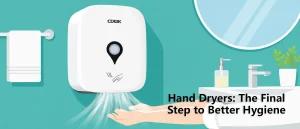
Correct Hands Washing Chain
Enter → soap dispenser delivers a consistent, sealed, uncontaminated dose → hands are scrubbed properly → hands are dried fully and quickly by filtered air → hands leave clean and dry.
Break any link and the outcome degrades. Too little soap and there is no lather. Contaminated soap and the wash adds organisms instead of removing them. No effective drying and the clean hands immediately become a transfer surface.
This is what a competent washroom specification should be built around — not a list of individual products, but an engineered sequence where each element supports the next one.
Conclusion
“Wash your hands” is the message the public hears. Delivering the conditions in which people can wash and dry their hands properly is the job of the facility.
That job runs through the soap dispenser that measures the soap and keeps it clean, and through the Hand dryer that finishes what the wash started. Get those two right, and the twenty-second habit the guidance asks for becomes something people can actually do — every time, in every washroom, without thinking about it.
Hand hygiene is a system. Build it that way, contact with CDWK to get more details.