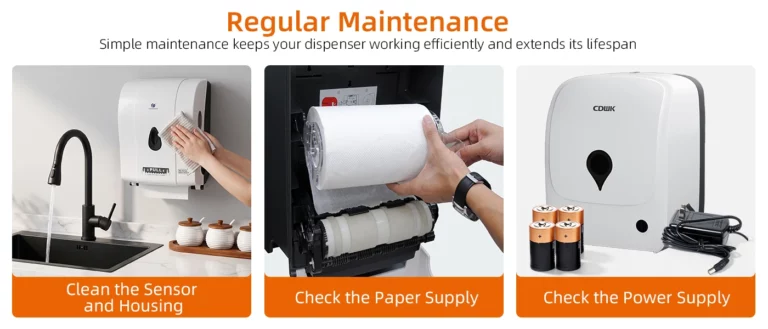

Public hygiene products are essential facilities for maintaining clean, comfortable, and sanitary environments in commercial and public spaces, including office buildings, shopping malls, hotels, schools, and public restrooms. Unlike disposable protective supplies, daily public hygiene equipment such as automatic soap dispensers, commercial tissue boxes, and smart aroma diffusers focuses more on long-term durability, user safety, hygiene performance, and suitability for high-frequency public use. Many buyers only focus on appearance and low price when sourcing public hygiene products, ignoring core factors such as material safety, anti-bacterial performance, and operational stability, resulting in frequent failures, secondary pollution, and poor user experience. This article shares professional purchasing tips and key considerations for these three mainstream public hygiene products to help you select cost-effective, hygienic, and durable equipment.
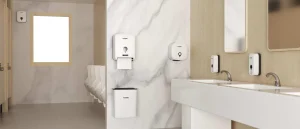
First of all, material safety and anti-corrosion performance are the top priorities for public restroom hygiene equipment. Public spaces feature high-frequency use, humid environments, and easy contamination, so product materials must meet strict public health standards. For commercial soap dispensers, high-quality ABS plastic and 304 stainless steel are the most reliable materials, which are anti-rust, anti-corrosion, and easy to clean. Avoid cheap recycled plastic dispensers, which are prone to cracking, yellowing, and bacterial accumulation after long-term contact with hand sanitizer and water. For public tissue boxes, thickened waterproof and dustproof materials are essential. Closed waterproof designs can effectively prevent toilet paper from being damp, contaminated by dust, or soaked, avoiding cross-infection for users. As for public aroma diffusers, the shell material must be high-temperature resistant and non-toxic, and internal atomization components need anti-clogging treatment to ensure stable long-term operation without releasing harmful substances.
Secondly, functional design must fit high-frequency public usage scenarios. Practical and hygienic design is the core difference between civilian household products and commercial public hygiene equipment. It is recommended to choose touchless automatic soap dispensers for public areas. The infrared induction design avoids direct hand contact, greatly reducing cross-contamination risks, with adjustable liquid output to avoid waste and dripping residue. Public tissue boxes should adopt a one-piece drawing design with a large-capacity storage space, suitable for intensive use in peak periods, and equipped with a visible window to facilitate staff timely replenishment. For commercial aroma diffusers used in lobbies, corridors and restrooms, buyers should select constant-temperature atomization and timed quantitative fragrance models. Uniform fragrance diffusion, no oil leakage, and no wet mist can avoid damaging floor and wall facilities, while improving public space ambiance without causing pungent odor discomfort.
Thirdly, verify product hygiene standards and safety certifications. As products closely related to public health, soap dispensers, tissue boxes and aroma diffusers must pass formal quality and safety tests. Check whether the equipment has anti-bacterial certification, food-grade material certification and EU CE safety certification. The inner container of soap dispensers must be non-oxidizing and compatible with various hand sanitizers and disinfectants to prevent chemical reactions and harmful substance precipitation. The fragrance oils matched with aroma diffusers must meet public environmental hygiene standards, free of formaldehyde, benzene and harmful fluorescent agents, ensuring harmless inhalation for the elderly, children and sensitive groups. Uncertified products may hide hygiene hazards and fail to meet public space health inspection standards.
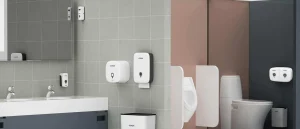
In addition, durability, maintenance cost and after-sales service cannot be ignored. Public hygiene equipment needs long-term continuous operation, so stability and easy maintenance are crucial. High-quality soap dispensers have durable induction sensors and leak-proof sealing structures, reducing frequent maintenance and replacement costs. Standard commercial tissue boxes have wear-resistant and drop-resistant designs, adapting to crowded public environments. For aroma diffusers, choose products with overheating protection and automatic power-off functions to avoid safety accidents caused by long-term operation. Meanwhile, prefer formal brands with complete after-sales support, which can provide professional installation guidance, accessory replacement and after-sales maintenance services.
Finally, balance practicability and cost performance. Excessively low-cost public hygiene equipment often has thin materials, unstable functions and short service life, increasing long-term replacement and maintenance costs. There is no need to blindly pursue over-functional high-end products. When purchasing public hygiene products, you should not only compare prices but also assess the total lifecycle cost. According to the space size, passenger flow and usage scenarios, selecting matched specifications and styles can maximize cost performance.
As a procurement rule, reliable public hygiene products always strike a balance between safety, function and service life. In short, the procurement of public hygiene products such as soap dispensers, tissue boxes and aroma diffusers should focus on safety certification, material quality, scenario-based functionality and long-term stability. Scientific selection can effectively improve the sanitary level of public spaces, reduce hidden health dangers, and create a clean, safe and comfortable environment for all users.