
Maintaining hygiene in communal areas is a global issue. In crowded international airports, shopping centers, or corporate office blocks, the sanitary condition of toilet stalls becomes an important factor determining the users’ safety and satisfaction. In order to reduce these health risks, managers use protective barriers. Nonetheless, one faces the hard task of choosing between paper and plastic when deciding on supplies. A comparison of the two toilet seat covers public restrooms in terms of sanitation, environmental impact, convenience, and operating costs reveals which material suits you better.
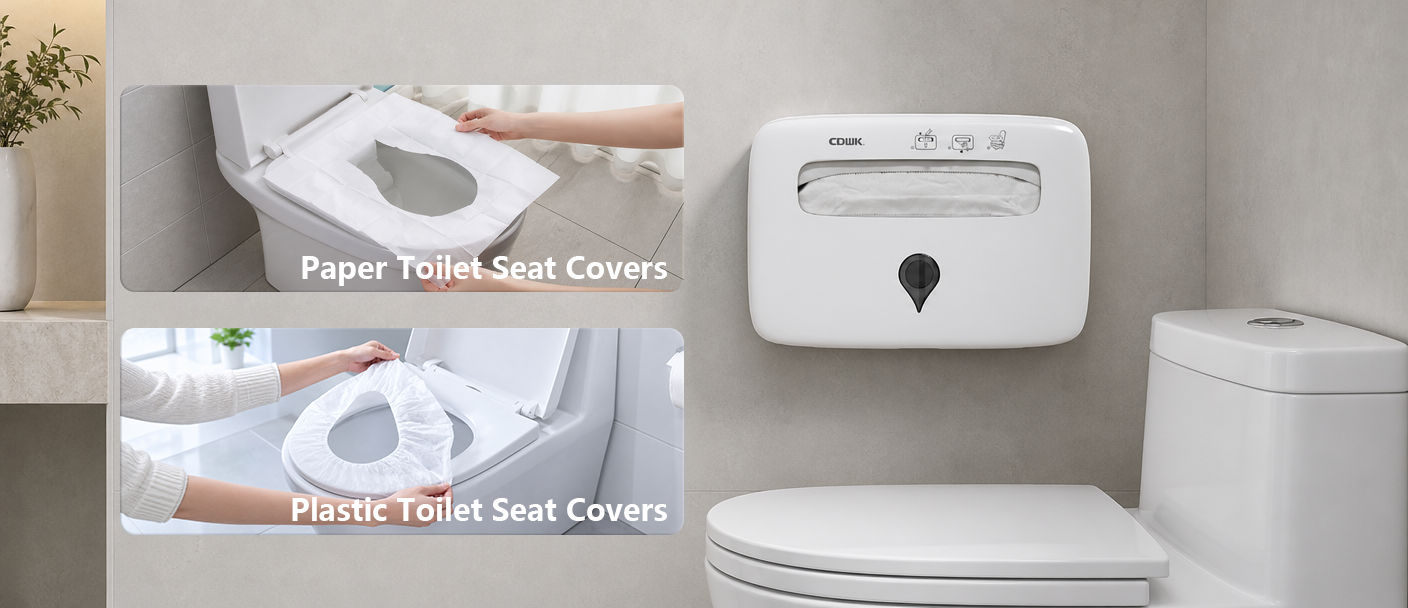
1. Quick Comparison: Paper vs. Plastic Seat Covers
To visualize how these two toilet seat cover solutions perform in high-traffic settings, the comparison table below outlines key operational parameters:
| Evaluation Criteria | Paper Covers | Plastic Covers |
| Moisture Resistance | ★★☆☆☆ | ★★★★★ |
| Eco-Friendliness & Biodegradability | ★★★★★ | ★★☆☆☆ |
| Plumbing Blockage Risk | ★★★☆☆ | ★★★★★ |
| User Operating Convenience | ★★★☆☆ | ★★★★★ |
| Initial Dispenser Investment | ★★★★★ | ★★☆☆☆ |
2. Hygiene & Protection in Toilet Seat Covers Public Restrooms
The surface of toilet seat covers public restrooms is often moist with micro-droplets, bacteria such as E. coli and Staphylococcus. An essential purpose of protective sheeting is to provide a physical barrier between human skin and the seat surface.
Physical Limitations of Paper Sheets:
Paper sheets are usually produced from wood pulp or recycled fiber and have a thickness of 14-16 gsm. In case of contact with bone-dry surfaces, it works well, but if the surface of the seat has any fluids, the sheet gets saturated in 3-5 seconds. At this point, the sheet gets dissolved and makes it possible for the user to get in touch with moisture and contaminants on the surface.
Impervious Isolation with Plastic Sheets:
High-density polyethylene or polyethylene plastic sheets have a thickness of 12-15 microns. Synthetic materials used to make plastic sheets are hydrophobic, which ensures 100% isolation of the surface from moisture. When combined with a motorized rotating system, a new plastic sheet slides over the ring automatically.
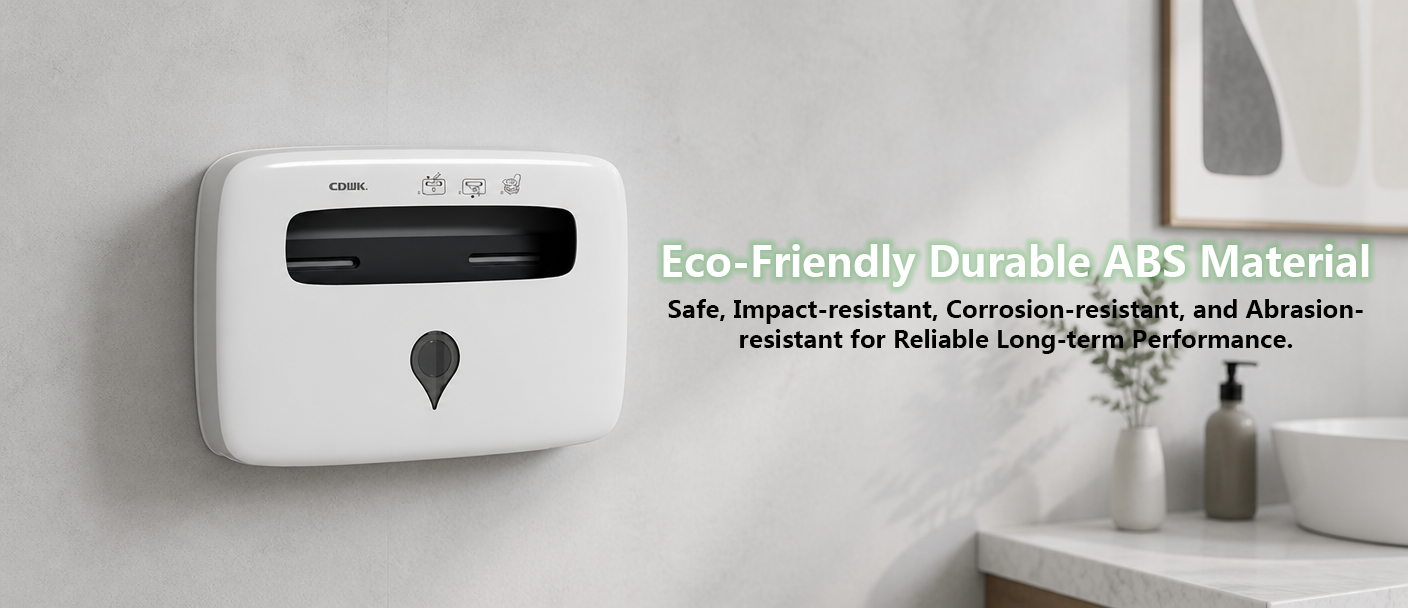
Sanitation optimization does not end at the choice of raw material because the storage equipment is equally essential. In paper-based systems, the use of strong storage equipment such as the wall-mounted CDWK CD-8029 dispenser ensures that the stored tissues remain dry through the use of stainless steel storage enclosures that are not easily invaded by airborne water and moisture prior to withdrawal.
3. ECO-FRIENDLINESS AND SUSTAINABILITY OF TOILET SEAT COVERS Public Restrooms
As companies adopt ESG guidelines in their business practices, the ecological impact of consumable restroom supplies has become one of the most important factors in buying decisions.
Biodegradable Features of Paper Solutions
The tissue solutions based on paper products have excellent flushability. The high-quality virgin tissue paper disperses into microfibers within 10 to 15 seconds after contact with the running water in the drain pipes. This avoids any clogging in the municipal sewage pipes. Moreover, coming from sustainably managed forests, the paper breaks down naturally in 2 to 4 weeks.
Waste Management Challenges with Synthetic Plastics
While most automatic plastic dispensers use recyclable material, in practical terms, the degree of sanitary waste contamination makes recycling impossible. Used sleeves end up in landfills or incineration facilities, requiring 200 to 500 years to degrade naturally. The absence of a closed-loop recycling system prevents recycling, causing continuous use of plastic to add to an organization’s solid waste generation.
4. User Experience and Convenience with Toilet Seat Covers Public Restrooms
Modern public installations should strive to provide a comfortable experience and easy operation for users.
Manual Placement Challenges
Users have to individually tear a sheet of paper, unfold it, and then position it carefully on the toilet seat. When used in damp environments or air-conditioned cubicles, paper sheets tend to adhere to surfaces or fly away due to electrostatic charges.
Automatic Mechanical Dispensing
Automatic mechanical dispensers start with the assistance of infrared sensors or a simple push of a button, sliding a new sleeve on the toilet seat within 2 seconds.
5. Cost & Maintenance of Toilet Seat Covers Public Restrooms for Businesses
Facility Managers must weigh up initial acquisition costs along with operating costs in order to find out the total cost of ownership.
Comparing Consumables Unit Cost Against Hardware Cost
The unit cost of refills is extremely low – about $0.01-$0.02 per paper sheet with a cheap wall dispenser. The cost of automated plastic systems is $50-$150 per electronic dispensing unit, as well as additional sleeve roll cost at $0.03-$0.05 per cycle.
Risks of Plumbing Against Labor of Janitors
Even though paper sheets are less expensive, careful customers tend to place 2-3 sheets together. This doubles the use of materials and increases the chance of pipe blockage. Fixing clogged pipes in a business establishment usually costs from $150 to $300 per service visit. Plastic sleeves, on the other hand, cannot be flushed, completely eliminating the risk of plumbing obstruction; however, janitors will have to take out the garbage bins more often.
6. What Should You Use for Toilet Seat Cover in Public Bathrooms?
In order to pick the right toilet seat covers public restrooms, one needs to compare their performance capabilities to characteristics of your building’s traffic, plumbing system, and budget restrictions:
Situations Suitable for Paper Seating Solution:
- Moderate Footfall and Economical Facility Operations: Educational establishments, municipal library systems, regional municipal buildings, and mid-sized commercial offices
- Building-Certified Facility Operations: Facility operations that strive towards achieving zero-landfills, LEED certification, or stringent environmental standards.
- Facilities with High Flow Plumbing: Facilities with state-of-the-art high-pressure flush valves and optimal drain slopes.
Ideal Facility Conditions for Plastic Seat Covers:
- High-Traffic and Highly Sanitary Facilities: International airports, transit hubs, medical facilities, and high-density exhibition venues.
- Luxury Facilities: Five-star hotels, private medical facilities, class-A office spaces, and luxury retail spaces.
- Facilities with Aging Plumbing Capabilities Prone to Pipe Blockages from Flushing.
Conclusion
Paper and plastic seating barriers both have their respective advantages. While toilet seat covers public restrooms are an economical and environmentally-friendly solution for regular commercial settings with a low cost of entry, plastic covers offer total fluid isolation and touchless convenience. Selecting appropriate supplies according to the type of facility operation, footfall, and plumbing will create a clean and efficient restroom environment.
In case of queries about supply selection, dispenser installation, or bulk commercial buying, please contact CDWK at any time.