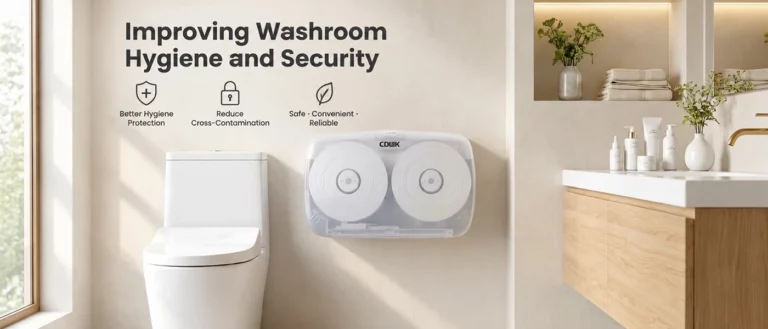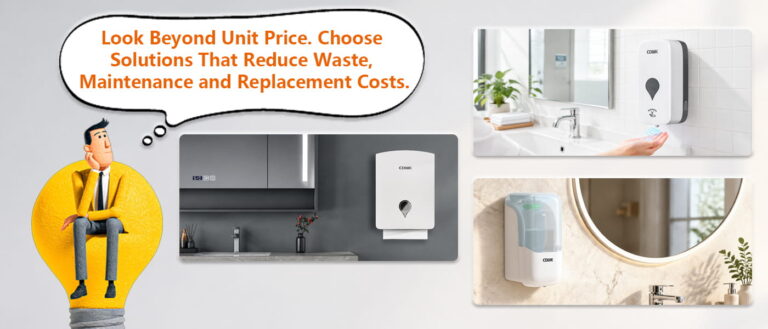

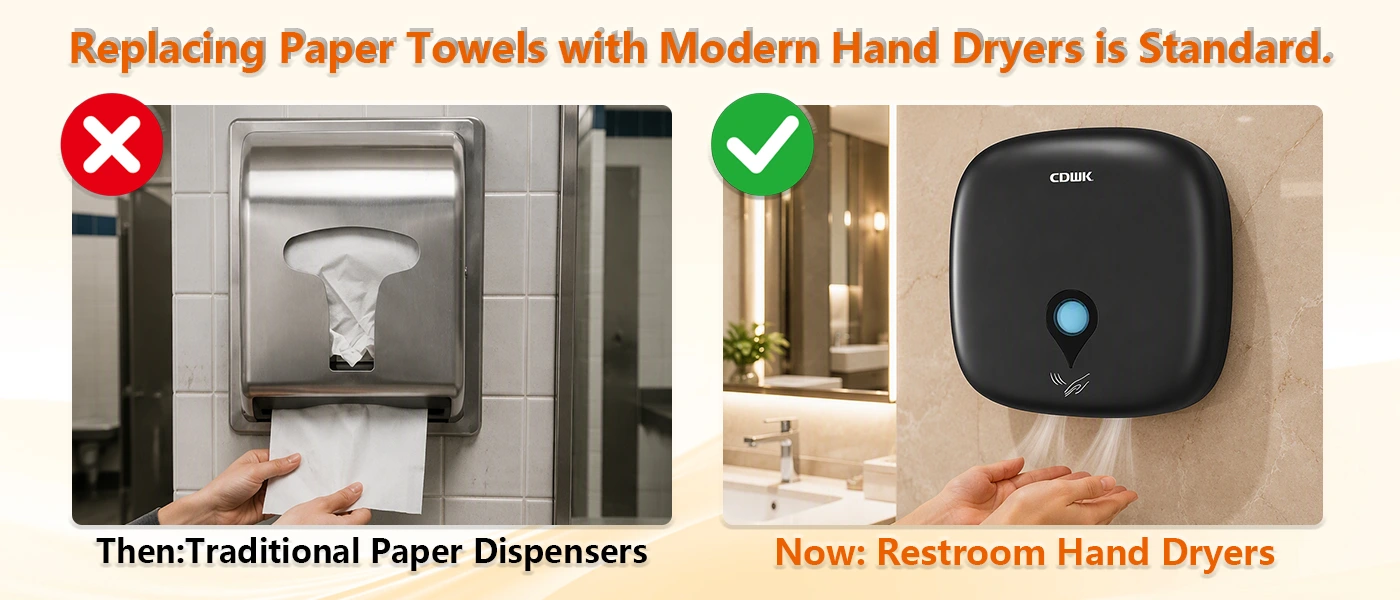
In the context of modern commercial facility management, public restrooms can be viewed as one of the central places where standards of buildings, their environmental responsibility, and cleanliness are reflected. Regardless of whether facility managers operate an international airport, a shopping center, a healthcare institution, or an office building, they are constantly looking for devices that will provide both convenience to users and efficiency regarding costs incurred. In this respect, modern commercial restroom hand dryers have become an integral element and have completely replaced paper towel dispensers.
1. Why are commercial restroom hand dryers needed?
Facilities with public and commercial bathrooms face constant stress due to the hardware involved. Installing efficient commercial restroom hand dryers has benefits that are far beyond mere hand drying:
Large Cost Savings in the Long Run
Although high-quality electronic hand dryers involve an initial cost, paper towel dispensers are associated with continuous costs such as purchase, delivery, restocking, and disposal. Switching to automatic dryers results in a significant reduction in regular restroom maintenance expenses by up to 90%.
Enhanced Hygiene and Touchless Features
The current generation of commercial restroom hand dryers uses infrared sensors, and thus one can dry his or her hands without making contact with any surface. High-end machines have medical-grade HEPA filters that capture up to 99.97% of bacteria and airborne particles before the air comes into contact with skin.
Eco-friendliness and LEED Points
Producing, delivering, and disposing of paper towels results in huge carbon emissions. The use of energy-efficient commercial restroom hand dryers helps in cutting down on waste in landfills as well as timber consumption.
Maintenance Reduction and Plumbing Problems
Used paper towels still pose the main problem of litter in the bathrooms, as used paper towels usually fill up the trash containers or create serious plumbing problems when flushed. Automated systems remove the physical waste of paper.
2. The 5 Best Commercial Restroom Hand Dryers
Selecting the ideal equipment depends on visitor volume, spatial layout, noise sensitivity, and available budget. The following five models represent top-tier commercial restroom hand dryers available in 2026.
Dyson Airblade 9kJ
Intended for premium commercial settings, the Dyson Airblade 9kJ has curved air-blade nozzles driven by a digital motor spinning at 75,000 RPM. Achieving maximum speeds of 624 km/h, it blows water off one’s hands within 10 to 12 seconds. Available in two operating modes (the Max Mode with 900W and Eco Mode with 650W), it consumes as little as 9.1 kilojoules of energy per hand-dry in Eco mode. Featuring an integral HEPA filter, this model is appropriate for heavy traffic locations, such as international airports and grade A office buildings.
Excel Dryer XLERATOReco
Commercial sites requiring extremely low energy usage and simplicity of design tend to use Excel Dryer XLERATOReco. This dryer does not have any heater, consuming 500W of power while blowing hands dry in 12 to 15 seconds through a directed high-velocity airflow. Since it uses less than one-third of the energy used by warm air dryers, several dryers can be powered by one circuit breaker.
CDWK Commercial Hand Dryers
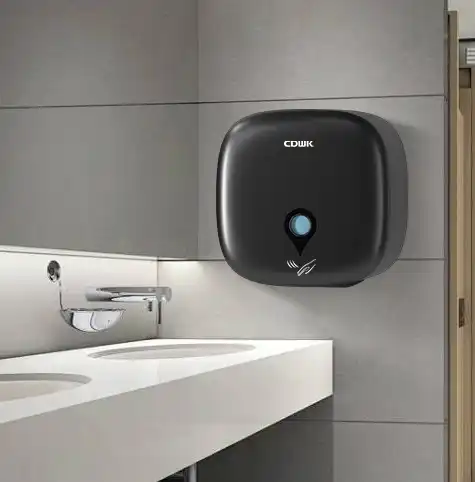
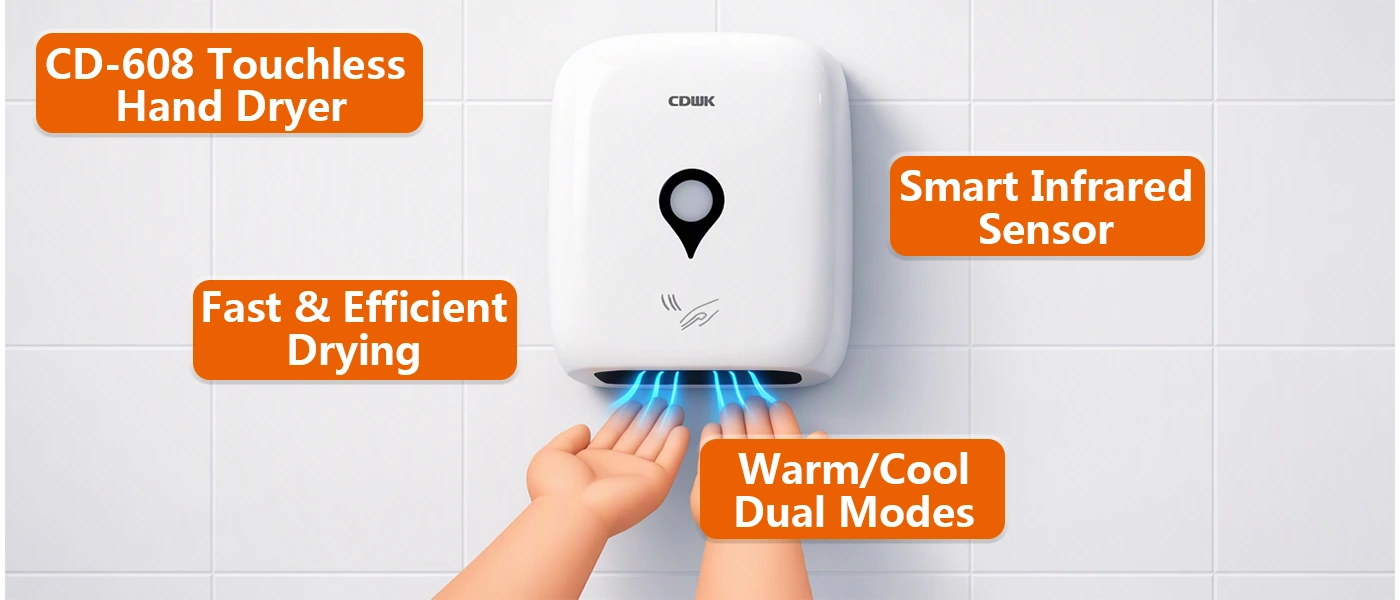
For those companies looking for a product that combines robustness, customization options, and affordability, the commercial hand dryer for bathrooms CDWK CD-608 is a viable choice. This commercial bathroom hand dryer is an effective and economical solution to the problem of disposing of paper towels because it lowers maintenance costs as well as the chances of cross-contamination. Driven by a 900 W motor with a high-speed airflow rate of 15 m/s, it provides efficient and fast hand drying through its smart chip control system. It has infrared detection technology (range: 1-15 cm), a blue breathing indicator light, as well as an easy-to-use toggle switch between cool and warm air.
World Dryer SLIMdri
Where space limitations and/or renovations of historical building structures apply, meeting the ADA requirements concerning protrusions is an important issue. The SLIMdri by World Dryer has a surface-mounted design that does not require wall-cutting for recessed mounting; it is 4 inches (10 cm) deep. It works at 950W of power and has drying cycles of 15 seconds, accepting universal voltage range of input current (110-240V).
Mitsubishi Jet Towel Slim
This type of drying unit remains highly popular in Europe and Asia for commercial purposes. It has a slot design where users insert their hands; they are dried by air nozzles blowing air at a speed of 110 m/s, which pushes water droplets into an internal collection tank, without spreading on the floor. It operates quietly, making noise at a range of 56-61 dB; therefore, it is ideal for noise-sensitive environments like hospitals, libraries, and high-end restaurants.
3. Comparison Table of Top 5 Commercial Restroom Hand Dryers for 2026
To help evaluate these five commercial restroom hand dryers, the table below breaks down key technical parameters and primary application scenarios:
| Brand & Model | Primary Technical Feature | Dry Time | Rated Power | Air Temp Control / Filtration | Ideal Application |
| Dyson Airblade 9kJ | Airblade technology, high air velocity | 10–12 sec | 650W – 900W | HEPA Filtration / Fixed Temp | Airports, Grade-A Offices |
| Excel Dryer XLERATOReco | No heating element, low wattage | 12–15 sec | 500W | Standard Filter / Unheated | Schools, Arenas, LEED Buildings |
| CDWK CD-608 | Durable housing, dual temp switch | 12–15 sec | 900w | Standard Filter / Hot-Cold Switch | Hotels, Restaurants, Workplaces |
| World Dryer SLIMdri | Surface mount, under 4″ depth | 15 sec | 950W | Standard Filter / Auto Heat | Small Restrooms, Retrofits |
| Mitsubishi Jet Towel Slim | Internal drain tank, quiet operation | 11–14 sec | 550W – 1240W | Drain Tank System / Multi-setting | Hospitals, Libraries, Fine Dining |
4. Conclusion
Market offerings of commercial restroom hand dryers by 2026 provide varied technology options that are suitable for varied applications. High-end models emphasize speed and clean air quality, while low-energy dryers focus on using minimal electricity. Selection of appropriate hardware should be based on assessment of daily patronage, budgetary considerations, available space, and acoustic requirements.
Installation of advanced commercial restroom hand dryers increases the efficiency of facilities in the long run and provides a superior service experience to everyone who visits these facilities.