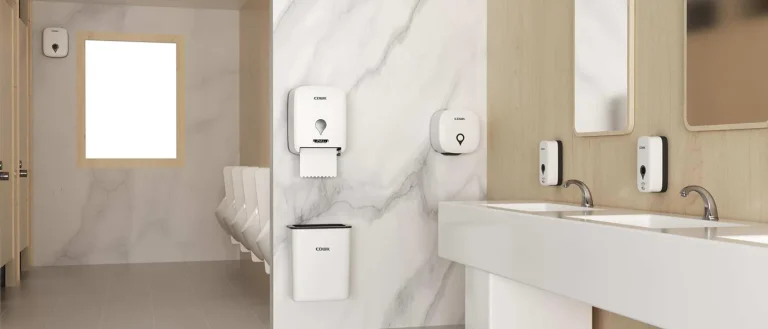

Wall-mounted paper towel dispensers form critical infrastructure for commercial washrooms. Facility buyers frequently face one core question: should they invest in manual paper towel dispenser or upgrade to sensor-activated touch-free dispenser?
Each option carries distinct strengths, weak points and total-cost profiles. There is no universal “better” solution; the right selection depends on visitor volume, hygiene priorities, maintenance capacity and project budget. By understanding real-world operational differences, procurement teams can avoid costly mismatches and pick hardware aligned with on-site conditions.
Both manual and sensor-driven dispenser solutions serve hotels, office buildings, transport hubs, restaurants and retail venues. Some projects even adopt a mixed deployment strategy: manual dispenser for back-of-house zones and touch-free sensor dispenser for customer-facing washrooms. Learning practical trade-offs supports well-informed purchasing decisions.
1. Manual and Sensor–Activated Dispenser: Core Operational Differences
What Key Traits Separate Manual from Touch–Free Dispenser?
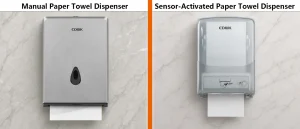
A heavy-duty manual paper towel dispenser relies purely on mechanical structures such as pull handles or lever mechanisms, with zero electronic components. Users trigger paper output through physical pulling or lever pressing. Quality manual dispenser units adopt thickened ABS or stainless-steel housing, anti-theft key lock and transparent viewing window. Since there are no sensors, batteries or circuit boards, mechanical failure points are greatly reduced.
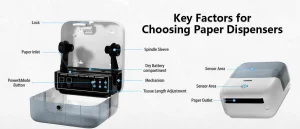
Sensor-activated paper towel dispenser applies infrared proximity technology. When users wave hands beneath the outlet, the unit automatically dispenses a preset length of paper towel without physical touch. Premium sensor dispenser allows adjustable paper output length and supports dual power supply by battery or mains electricity. While it elevates hygiene performance, this electronic hardware introduces new variables: battery consumption, sensor sensitivity calibration and potential circuit damage under humid washroom surroundings.
Below are core advantages each type delivers:
Reliable manual paper towel dispenser brings these practical benefits:
- Fully mechanical design, no battery or power supply required ·
- Lower upfront procurement cost for large-quantity projects ·
- Minimal maintenance; custodians only handle paper refilling and surface cleaning ·
- Stable performance in damp, dusty or temperature-fluctuating restroom environments ·
- Lever-style manual dispenser can cut paper waste by up to 40% with optimized mechanical structure
Well–engineered sensor–activated touch–free dispenser offers these highlights:
- Zero hand contact with dispenser shell, effectively lowering cross-contamination risks ·
- Fixed pre-set paper length restrains over-pulling and unnecessary paper consumption ·
- Modern touch-free appearance upgrades overall venue image for hospitality and premium commercial spaces ·
- Adjustable dispensing length adapts to different washroom user groups
Each category also comes with unavoidable drawbacks. Manual dispenser requires surface contact, which creates potential germ-transfer points; careless users may pull excessive paper and cause waste. For sensor dispenser, higher unit price raises initial investment; batteries need periodic replacement; sensors could suffer mis-detection when exposed to heavy steam or dust.
2. Key Factors to Consider When Choosing Between Manual and Sensor–Activated Paper Towel Dispensers
When you are deciding whether to install manual or touch-free sensor-activated paper towel dispensers for your commercial washroom projects, there are several core factors to weigh: expected traffic volume, hygiene-level requirements, power availability, long-term maintenance costs and reliable supplier selection.
Choosing a trusted, experienced manufacturer is critical to guarantee stable product performance and after-sales support for large-scale roll-outs across multiple sites. As an example, CDWK — a specialized manufacturer of commercial washroom hygiene hardware with its paper towel dispensers supplied to over 130 countries worldwide — offers both heavy-duty manual dispensers and sensor-activated touch-free models to meet diverse project demands.
For projects opting for manual dispensers, CDWK’s lever-type jumbo-roll paper towel dispenser features a thickened, impact-resistant ABS housing and a secure key-locking anti-theft structure. Its optimized lever-driven mechanism controls paper output and effectively cuts down paper waste. A transparent observation window allows cleaning staff to check remaining paper stock without unlocking the cabinet. This manual-operated unit delivers consistent performance in high-traffic locations such as chain hotels, office complexes and transport hubs. Since no power supply is required, it works perfectly for sites with unstable electricity or limited maintenance manpower.
If your projects prioritize enhanced hygiene standards, the sensor-activated paper towel dispenser is a strong alternative. Taking CDWK’s touch-free model as an illustration, it is fitted with a high-precision infrared sensor module and splash-proof internal protection. Buyers can select from multiple adjustable paper-output-length settings to match their requirements, and the dispenser supports dual power supply via batteries or AC power. Its splash-resistant inner structure safeguards electronic components even in damp washroom environments.
Hands-free operation removes physical contact with the dispenser surface, making this sensor-operated solution well-suited for high-hygiene venues including premium hotels, shopping centers and healthcare-related facilities. Flexible OEM / ODM options such as custom logo printing and bespoke packaging are also available from suppliers like CDWK, which is an added benefit for chain-wide branding projects.
3. Practical Reference: How to Decide Between Manual Dispenser and Sensor Dispenser
Guiding questions for facility procurement teams
When comparing manual paper towel dispenser and sensor-activated dispenser, buyers should evaluate four core dimensions: daily visitor volume, hygiene requirements, on-site maintenance resources and total project budget.
Application Scenario Matching
For medium-and-low-traffic zones: staff back-of-house areas, small-size serviced apartments, low-frequency restrooms in industrial parks. A heavy-duty manual paper towel dispenser is usually the cost-effective pick. It avoids recurring battery-replacement workload and maintains stable operation with simple upkeep.
For high-traffic customer-facing venues: airport terminals, large shopping plazas, downtown chain hotels, crowded food-service sites. Sensor-activated touch-free dispenser delivers extra value on hygiene and brand perception. Controlled fixed-length dispensing also lowers long-term paper-consumption expenditure.
Many real-world projects choose mixed deployment: install robust manual dispenser for non-public back zones, and roll out sensor-activated dispenser for guest-visible restrooms to balance budget and user experience.
Maintenance Capacity Assessment
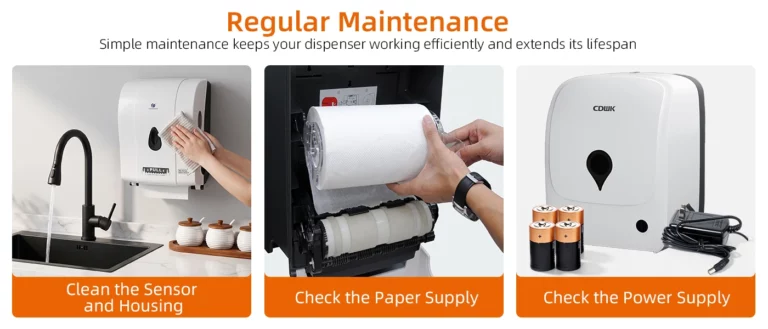
Procurement teams need to think about custodian staffing arrangements. Sensor dispenser requires regular battery inspection and sensor-lens cleaning to prevent dust-caused detection failure. If your site cannot guarantee routine electronic-part maintenance, high-quality mechanical manual dispenser will reduce unexpected downtime risk. Manual dispenser only demands paper refilling and routine shell wiping.
Budget Evaluation (Upfront Cost VS Long–Run Expense)
Manual dispenser features lower initial purchase cost for bulk orders. Yet uncontrolled over-pulling may generate higher ongoing paper-consumption cost. Sensor-activated dispenser costs more at procurement stage, but fixed-length output curbs paper waste. Buyers need to calculate total cost of ownership instead of only comparing unit price.
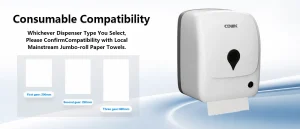
Consumable Compatibility
Whichever dispenser type you select, please confirm compatibility with local mainstream jumbo-roll paper towels. Good compatibility prevents extra costs brought by special-format consumables.
4. Industry Outlook for Paper Towel Dispenser Solutions
Global commercial-washroom hygiene standards keep evolving. Manual mechanical dispenser will retain irreplaceable market share for cost-sensitive, low-maintenance-demand projects. Meanwhile, sensor-activated touch-free dispenser keeps advancing: manufacturers optimize sensor anti-interference performance for steamy, dusty surroundings, extend battery service cycles and improve anti-jam mechanical structures. Mixed-solution deployment combining manual and touch-free dispenser will become a common procurement strategy for large-scale complex commercial facilities.
Conclusion
Neither manual paper towel dispenser nor sensor-activated touch-free dispenser can serve as an all-in-one perfect answer for every washroom project. The mechanical manual dispenser shines in reliability, low-maintenance workload and competitive upfront investment. The sensor-driven touch-free dispenser excels in cross-contamination prevention, standardized paper consumption and modern venue image upgrading.
Represented by CDWK, professional hygiene-hardware manufacturers supply both high-performance manual dispenser and sensor-activated dispenser. This enables procurement specialists to select or mix-match hardware solutions fully based on real-site visitor flow, hygiene standards, maintenance manpower and total-budget targets, rather than blindly preferring one technical route over another.
Before finalizing purchasing plans, facility buyers are advised to assess on-site restroom conditions comprehensively. Clarify your priority among initial investment, hygiene level, maintenance burden and long-term consumable expense, then pick the most suitable paper towel dispenser for your premises.