
Every facility manager, distributor, or purchasing professional who has ever sourced public hygiene products knows the feeling. There’s the excitement of a promising quote. The anticipation of a sample shipment. And then—the quiet dread of what actually arrives in the container.

On paper, buying public restroom essentials should be simple: soap dispensers, tissue holders, paper towel systems, sanitary units. They’re everyday objects. What could possibly go wrong?
Plenty. And in the public hygiene industry, the people who source these products professionally know that choosing a supplier is less like a routine purchase and more like an adventure—one where the map is unreliable, the terrain changes, and a wrong turn costs you far more than the invoice.
Here is what makes that adventure so treacherous, the principles that keep you on the trail, and why manufacturing substance—not marketing—is the compass you should follow.
Part One: Why Choosing Right Is So Hard
1. Identical Looks, Hidden Differences
Stand two soap dispensers side by side at a trade show and they can look identical. One is molded from virgin ABS with a tested pump mechanism rated for hundreds of thousands of cycles. The other uses recycled regrind that yellows, cracks, and jams within months.
You cannot see quality with your eyes for public hygiene supplies. It hides in material grade, wall thickness, spring tension, valve tolerances, and finishing—all of which appear at the moment of failure, not the moment of purchase.
2. The Race to the Bottom
In a global market where everyone claims “factory direct,” price becomes the only visible differentiator. But a price that looks too good almost always means hidden downgrades: thinner plastic, cheaper valves, shorter service life. The unit cost goes down; the cost per year of operation goes up.
3. Compliance and Material Risk
Public hygiene products sit at the intersection of hands, soap, and paper—every day, in public spaces. Material compliance matters: chemical resistance, food-contact safety where relevant, antibacterial performance, and durability standards that hold up under constant use. Non-compliant suppliers cut corners on materials that cannot pass third-party testing, and when that happens, the risk doesn’t stay with the manufacturer. It lands on your brand, your facilities, and your end users.
4. Trading Companies Disguised as Factories
A surprising portion of the “manufacturers” you meet online are trading companies or small workshops with no production lines, no R&D, no quality system. They can quote beautifully. They can even sample beautifully—with product borrowed from a real factory. But when something fails, they vanish, and you’re left holding the problem.
5. The Hidden Costs of Failure
Every jamming dispenser is a maintenance call. Every rusted holder is a replacement cycle. Every dripping valve is wasted soap and a complaint. When a public hygiene dispenser fails in a public restroom, the facility is briefly out of service, the cleaning staff is interrupted, and the user’s perception of your building changes.
The true cost of a supplier is never the unit price. It’s the total cost of ownership over years of operation—and that number is invisible in a quotation.
6. Fragmented and Inconsistent Supply
Product lines change without notice. Quality drifts between batches. Spare parts disappear. The “cheap” supplier you bought from last year becomes the unavailable supplier you can’t reach this year. In a category where facilities need consistency, predictability is not a luxury—it’s a requirement.
Part Two: Six Principles for Choosing Well
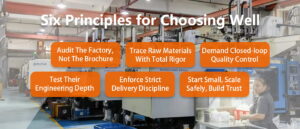
The adventure doesn’t have to end in disappointment. Experienced buyers follow a set of principles that separate real partners from risky bets.
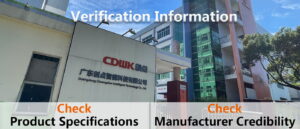
Principle 1: Buy the public hygiene supplies factory, not the brochure. Look past the website and the showroom. Ask about real production lines: injection molding, assembly, tooling, and inspection. Request factory audits, walkthrough videos, and—most importantly—independent third-party verification from recognized bodies such as SGS, TUV, or Intertek. A factory that welcomes scrutiny is a factory with nothing to hide.
Principle 2: Follow the materials. Demand material specifications and traceability. Ask which grade of plastic is used, where the springs and valves come from, and whether materials are virgin or recycled. Certifications are not decoration—they are evidence, and you should ask to see the reports behind them.
Principle 3: Insist on full-process quality control. A serious public hygiene manufacturer runs a closed quality loop: IQC for incoming materials, IPQC during production, FQC for final inspection, and OQC for outgoing goods. Ask how defects are caught, at which stage, and what the data says over time. The presence of a quality system tells you more than any promise.
Principle 4: Test their engineering depth. Catalog suppliers sell what already exists. Partners help you build what you need. Look for DFM—design for manufacturability—along with custom colors, logos, and functional modifications. If your project needs customization, this is the single clearest difference between a partner and a reseller.
Principle 5: Demand delivery discipline. On-time delivery is not a bonus; it is the business. A supplier who cannot manage production schedules, material planning, and logistics reliably will cost you in the form of delayed openings, empty dispensers, and broken commitments to your own customers. Ask for demonstrable delivery records, not assurances.
Principle 6: Choose a partner who makes it easy to start—and safe to scale. The best suppliers offer low minimum order quantities for trial, sample fees that are deducted from production orders, flexible inventory models such as VMI, and stable after-sales support. They understand that trust is built one small order at a time.
The Adventure Is Worth Taking—with the Right Partner
Choosing a public hygiene supplier will always be an adventure. There are too many variables, too much invisible quality, and too much distance between a quotation and a delivered container to make it risk-free.
But the buyers who thrive treat it the way all good adventurers do: they prepare, they verify, and they choose their companions carefully.
With the right principles—and a manufacturer with 23 years of audited, measurable, engineering-backed substance—the adventure stops being a gamble. It becomes a partnership, and that is the best outcome any buyer can ask for.
Ready to choose a public hygiene supplier you don’t have to gamble on? Talk to CDWK.