
Choosing the right commercial dispenser is about more than simply selecting the largest model available. A dispenser that is too small may require frequent refilling, while an oversized model can take up unnecessary space and increase your initial investment.
For offices, hotels, restaurants, hospitals, shopping malls, and other commercial facilities, the right dispenser capacity depends on several factors, including daily traffic, consumption, refill frequency, peak usage, and available space.
So, how can you determine the right capacity for your facility? Let’s explore the key factors to consider before making a purchase.

Why Does Dispenser Capacity Matter?
Dispenser capacity directly affects daily facility management.
If a dispenser runs out too quickly, cleaning staff need to refill it more often. This increases maintenance workload and may create an unpleasant experience for visitors if paper towels, toilet paper, or soap are unavailable.
However, choosing a dispenser that is much larger than necessary is not always a better solution. It may take up valuable wall space and may not be practical for smaller restrooms.
The goal is to find the right balance between capacity, usage, space, and maintenance.
1. Start With Daily Traffic
The first factor to consider is how many people use the facility each day.
A small office with a few dozen employees has very different requirements from an airport, shopping mall, or large hospital serving hundreds or thousands of visitors.When estimating usage, consider:
- Number of employees
- Average daily visitors
- Customer traffic
- Peak hours
- Weekday and weekend usage
- Seasonal changes
For example, a restaurant may experience significantly higher restroom traffic during lunch and dinner, while an office may have a more predictable usage pattern.Understanding your daily traffic helps you estimate how quickly the dispenser will need to be refilled.
2. Consider Your Refill Schedule
Dispenser capacity should also match your cleaning and maintenance schedule.Ask yourself:How often can your cleaning staff realistically refill the dispenser?
If a restroom is checked several times a day, a compact dispenser may be sufficient.However, if the facility is only serviced once or twice a day, a higher-capacity dispenser can reduce refill frequency and maintenance workload.
This is particularly important for large facilities where cleaning staff may need to manage many dispensers across different areas.
3. Plan for Peak Usage
Average daily traffic does not always reflect actual demand.Usage can increase significantly during:
- Weekends and holidays
- Lunch or dinner periods
- Conferences and events
- Tourist seasons
- Promotional activities
Choosing a dispenser capacity based only on average usage may leave it empty during busy periods.For this reason, it is better to choose a model with some additional capacity to handle unexpected increases in demand.A little extra capacity can provide a more reliable user experience and reduce the risk of emergency refilling.

4. Match Capacity to Your Facility
Different facilities have different requirements.
Small Offices
Small offices generally have predictable traffic and regular maintenance schedules. A compact dispenser can often provide sufficient capacity while saving valuable wall space.
Restaurants and Cafés
Restaurants can experience significant changes in traffic throughout the day. The right dispenser capacity should be sufficient to handle busy periods while remaining easy for staff to refill and maintain.
Hotels
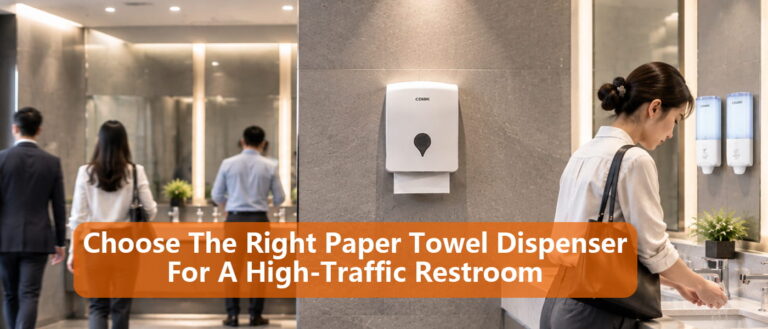
Hotels may have guest rooms, public restrooms, restaurants, conference areas, and staff facilities. Capacity should therefore be selected according to the traffic level of each location.Public restrooms and event areas may require higher-capacity models, while lower-traffic areas can use more compact solutions.
Hospitals and High-Traffic Facilities
Hospitals, shopping malls, airports, and other high-traffic facilities often benefit from higher-capacity dispensers. Reducing refill frequency can help improve operational efficiency and reduce maintenance workload.However, dispenser capacity should still be balanced with installation space and consumable compatibility.
5. Check Consumable Compatibility
Dispenser capacity is not the only specification that matters.
The actual amount of paper, toilet tissue, or soap a dispenser can hold depends on the type and size of the consumable.For paper towel dispensers, check:
- Paper dimensions
- Fold type
- Sheet count
- Paper thickness
- Roll diameter
- Roll width
- Core size
For toilet roll dispensers, roll diameter and core size are particularly important.For soap dispensers, capacity is usually measured in milliliters, but refill frequency also depends on the dosage per use.
Always confirm that the dispenser is compatible with the consumables you plan to use. A dispenser with a large internal volume may not achieve its expected capacity if the paper or refill size is not suitable.
6. Consider Installation Space
A higher dispenser capacity usually requires more internal space, but bigger is not always better. Before choosing a model, consider:
- Available wall space
- Dispenser depth
- Installation height
- User accessibility
- Maintenance access
For a small restroom, a compact dispenser may provide a better overall solution.For a large public restroom, a higher-capacity model may be more practical because it can reduce the frequency of refilling.The ideal dispenser should provide enough capacity without becoming unnecessarily bulky.
7. Look Beyond the Initial Price
When comparing commercial dispensers, it can be tempting to focus only on the purchase price.However, the total cost of a dispenser also includes:
- Refill frequency
- Maintenance labor
- Replacement parts
- Product lifespan
- Consumable waste
A lower-priced dispenser may not always be the most cost-effective option if it requires frequent refilling or maintenance.For commercial facilities, it is better to consider the total cost of ownership and long-term operational efficiency.

Conclusion
There is no single dispenser capacity that works for every facility.
The right choice depends on daily traffic, consumption, refill frequency, peak usage, available space, and maintenance requirements.
A small office may benefit from a compact dispenser, while an airport, shopping mall, or hospital may require a higher-capacity solution.
The best commercial dispenser is not necessarily the biggest one. It is the one that provides enough capacity for your facility’s actual needs while keeping maintenance, space, and operating costs under control.
By understanding your facility’s usage patterns before purchasing, you can choose a dispenser that delivers a better balance of hygiene, convenience, efficiency, and long-term value.